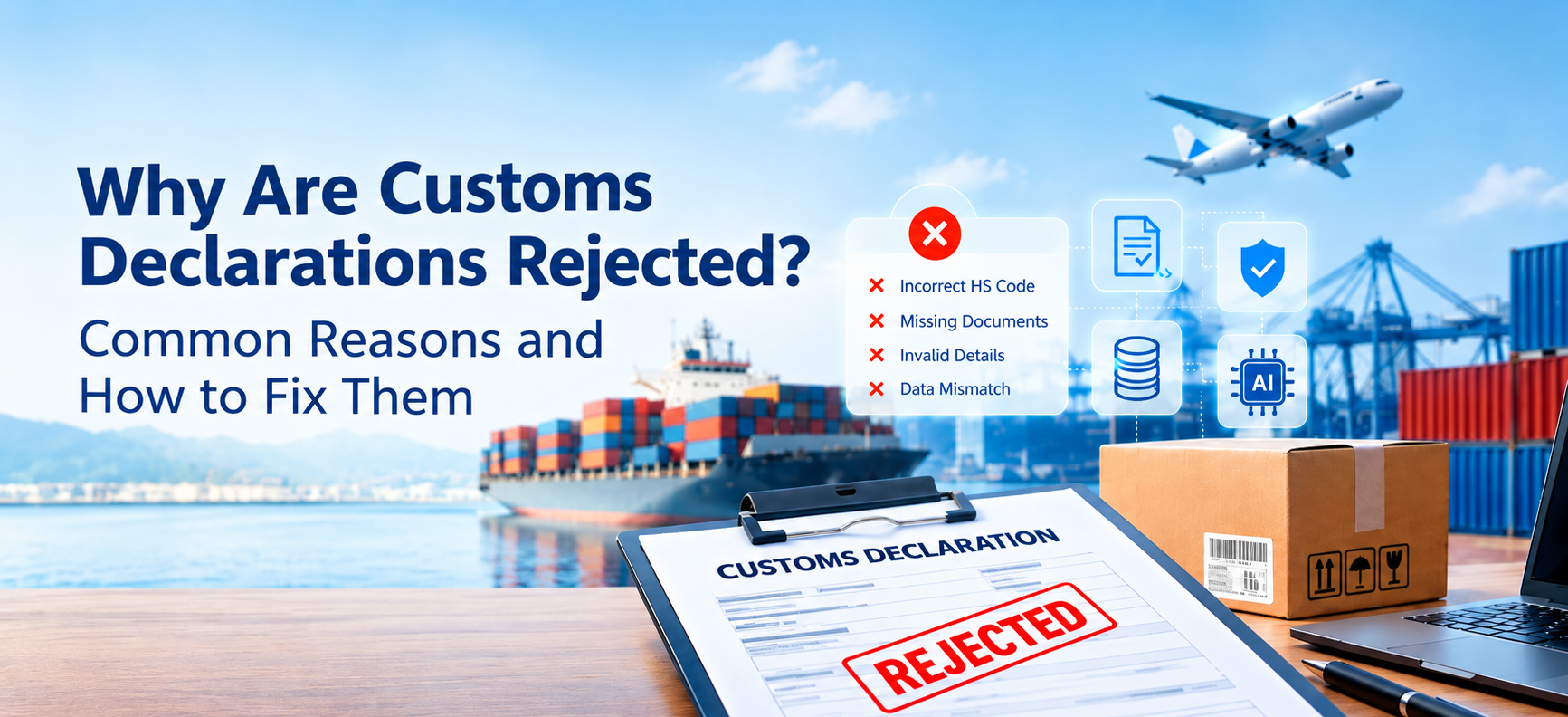
Why Are Customs Declarations Rejected? Common Reasons and How to Fix Them
What Is a Customs Declaration Rejection? Rejected Declaration vs. Customs Hold What Happens After a Declaration Is Rejected? Common Reasons Why Customs Declarations Are Rejected How AI and Automation Help Reduce Customs Declaration Rejections Conclusion Frequently Asked Questions
Customs declaration blunders can turn an otherwise normal international shipment into an expensive setback. An absent document, wrong product code, inconsistent invoice amount, or invalid business ID can cause customs to deny the shipment from being cleared through the customs system. In order to facilitate movement of goods and maintain compliance, it is important for importers, exporters, customs brokers, and freight forwarders to have a good understanding of the reasons for rejection of customs declaration.
The good news is that many rejections could be avoided simply by providing accurate shipment data, consistent customs paperwork, and employing a proper review process. This guide outlines the most frequently occurring reasons for failure of customs declarations, explains how filing mistakes can be fixed, and shows how businesses can avoid encountering similar issues in the future through improvement of processes and implementation of AI-powered automation systems.
What Is a Customs Declaration Rejection?
A customs declaration indicates the information being declared concerning the goods imported or exported from a country. Depending on the shipment and the destination, it may contain a description of the products, commodity codes, values of the cargo for customs purposes, country of origin, quantity of the goods, transportation details, and supplementary documentation.
This information is used by the customs authority for assessing duties and taxes, enforcing the restrictions on imports and exports, and verifying compliance of the goods with the customs regulations.
The term declaration rejection is used in the case when the submitted declaration has not passed the necessary validation check. This means that the declaration submitted must correspond to the formal requirements established for filing. For instance, there can be a situation when the electronic system rejects a declaration since it is missing an obligatory field or two related fields have contradicting data.
Rejected Declaration vs. Customs Hold
These situations are connected but distinct from each other:
- Refused declaration: The declaration has not met the validation or acceptance requirements. The declarant should amend the details and submit a new declaration or follow the relevant correction process.
- Customs hold: The declaration has been accepted, but the shipment is undergoing additional checks, documentation, inspection, or regulatory review.
Knowing the distinction enables you to take the right next step instead of submitting the same wrong information repeatedly.
What Happens After a Declaration Is Rejected?
The procedure depends on the customs regime and kind of objection. You may be prompted with an error message providing the data field that is affected. You should understand the message and verify the filing procedure to overcome the issue and perform the resubmission or amendment.
For instance, guidance in the UK claims that in case of some pre-lodged import customs declarations rejected on arrival you cannot make amendments; you have to re-file it with the mistakes corrected.
Common Reasons Why Customs Declarations Are Rejected
What happens to straightforward shipments that end up with issues? Often, it is not the shipments nor the object being sent that cause issues. The trouble here is rather with wrong, insufficient, or contradictory information provided during the procedure.
1. Wrong or Missing HS Codes
The Harmonized System (HS) code serves as a basis for identifying and categorizing the objects. The HS code can impact customs duties and tariffs, restrictions, and licensing measures.
Incorrectly classified goods should not be allowed to pass customs. How to resolve the problem:
- Check the properties and functions of the product.
- Consult the national tariff and customs rules.
- Check for the requirements required by the destination country.
- Make sure to verify whether the code requires special licenses or certificates.
- Do not use the same code for a similar product used in the previous shipment of goods.
2. Missing or Inconsistent Customs Documentation
Customs declarations are often based on invoices, packing lists, transport documents, licences, certificates of origin or other documentation. Documents that must be used depend on the type of goods and mode of transport and destination as well as on relevant legislation.
Failure of declaration can occur because of missing document references, incorrect codes or misalignment between declaration and supporting documents. Fixing declaration failures involves:
- Finding out what the mandatory documents for the shipment are.
- Ensuring that document references and codes are compliant with the applicable filing rules.
- Comparing the invoice, packing list and declaration before it is filed.
- Making sure that all permits or certificates required are valid and in place.
Using a standard checklist for customs documentation will enable to make the process of eliminating such failures more repeatable.
3. Incorrect Customs Value or Currency
Customs value is significant since it can play a role in determining the amount of duties and taxes payable. One example of a potential error relating to customs value is the declared customs value not complying with the law concerning customs valuation or the applicable costs not being accounted for properly.
Moreover, errors in respect of currency, wrong invoice amounts, and incorrect subtractions or additions can cause problems.
What to do:
- Establish the value stated in the invoice, as well as the currency used for it.
- Investigate the legal rules applying to customs valuation in respect of the destination.
- Establish what shipping, insurance, and other costs must be taken into account according to the appropriate valuation procedure.
- Ensure that the terms of the sale and the declared valuation adjustments are correct.
- As far as complex transactions involving related parties and payment conditions are concerned, get consultations from a customs expert.
4. Invalid or Missing Importer and Exporter Details
The customs authorities might ask for relevant business numbers, registration codes, and identification details of the parties involved in the business. An example in this context is the EORI being used in the UK and EU for customs purposes.
Important to note is that a problem can arise when there is no number, the number is invalid, the number does not belong to the right entity, or the number is inconsistent with the rest of the documentation.
Fixing the problem:
- Make sure that the proper registration information is available about the importer and the exporter.
- Make sure that the number is tied to the appropriate business.
- Make sure that the party in question is involved in the process properly.
- Review if the type of activity and the destination are associated with any registrations.
5. Inaccurate Product Descriptions, Quantities, or Weights
Term such as “parts,” “equipment,” or “accessories” may be rather ambiguous to allow accurate classification. Mistakes in quantity, net weight, gross weight, number of packages, or measuring units may also lead to discrepancies.
These errors usually occur when information is transferred by hand from invoices, logistics systems, and customs documents. How to resolve this issue:
- Provide an accurate description of the goods indicating their specifications.
- Double-check the number of goods packaged according to the packing list.
- Make sure to confirm net and gross weights in the necessary units of measure.
- Create correspondence between the item-level totals with that at the shipment level.
6. Missing Licences, Certificates, or Required Data Fields
An extra paperwork or permissions will be required for some items. According to the product classification and destination, the extra documentation could be permits, licenses, safety certificates, or some other regulatory documents. The complete declaration will not always pass if a required document is not presented or a compulsory field is incorrectly filled in the declaration. To solve the problem:
- Find out what tariffs and restrictions are applicable.
- Figure out what documents are necessary for this product.
- Make sure that the right document codes and references are indicated.
- Fill in every required field based on the appropriate guide for the system.
7. Incompatible Data and Electronic Filing Errors
Not all refusals are caused by a single field missing. Electronic customs systems may validate certain fields together. For instance, trade terms and valuation adjustments may have to correlate with each other. Incorrect date formats, incorrect codes, incompatible data pairs, or formatting errors in uploaded documents may also lead to failed submission. How to resolve:
- Read the complete error message and not just concentrate on the first field mentioned.
- Examine all related data elements recognized by the system.
- Check the codes, formats, dates, and necessary fields according to the current filing guidelines.
- Choose appropriate instructions for a certain declaration type and customs platform.
How AI and Automation Help Reduce Customs Declaration Rejections
When businesses have to manage large shipping volumes and receive data in various formats, manual data entry can be difficult. By automating these processes with AI, it is possible to simplify shipment data processing.
1. Automated Data Extraction from Shipping Documents
AI allows automated processing of documents such as commercial invoices, packing lists, and other trade documents. That means there is no need to enter the same data manually multiple times.
However, despite AI being able to extract information, it must still be verified against the original documents, especially when the materials being scanned are of poor quality or contain unclear descriptions of the product itself.
2. Data Validation and Error Identification
Auto-validation enables the system to detect missing information, inconsistencies as well as differences between the document, and so on. Thanks to this, customs officers can spot the issues in advance before the documents are submitted.
The success of the provided checks depends on the quality of the data being checked and the implementation of the validation rules as per existing regulations.
3. Quick Declaration Preparation
By linking document extraction, data verification, and work flow, people can devote less time to monotonous admin tasks and more time to solving issues. The burden of handling more shipments can be lessened by customs brokers and forwarders without relying totally on manual assistance.
Businesses exploring these capabilities can learn more about Droblet AI's customs declaration solution, which focuses on automating ENS-related declaration workflows.
Using automation does not guarantee acceptance of customs declarations, nor does it substitute for customs experience. However, it allows people to make declarations easier and spot problems on time.
Conclusion
When the customs declaration is rejected, it is usually because of the occurrence of avoidable issues such as incorrect information, lack of required documents, wrong classification, and mismatched electronic forms. If these problems remain unaddressed, they will result in delays in shipment, extra costs, and compliance problems.
To deal with these issues, a systematic process of document verification, shipment information validation, error elimination, and outreach monitoring should be established.
For companies engaged in international trading, the combination of unambiguous procedures with AI-based document processing and validation can reduce the occurrence of repetitive operations and ensure accuracy of declarations.
Frequently Asked Questions
1. Why are customs declarations rejected?
Customs declarations are commonly rejected due to incorrect HS codes, missing documents, inaccurate values, or incomplete shipment information.
2. Can a rejected customs declaration be resubmitted?
Yes, in many cases. Correct the identified errors and follow the customs authority’s procedure for resubmission or amendment.
3. How can I check why my customs declaration was rejected?
Review the rejection notification and error codes, then consult the relevant customs authority’s official guidance.
4. How can businesses prevent customs declaration errors?
Verify shipment details, check supporting documents, use standardised checklists, and validate information before submission.
5. Can AI help reduce customs declaration rejections?
Yes. AI can extract document data, identify missing information, and flag inconsistencies before submission, helping reduce preventable errors.
Rudratej Patil
Co-founder
Droblet Technologies