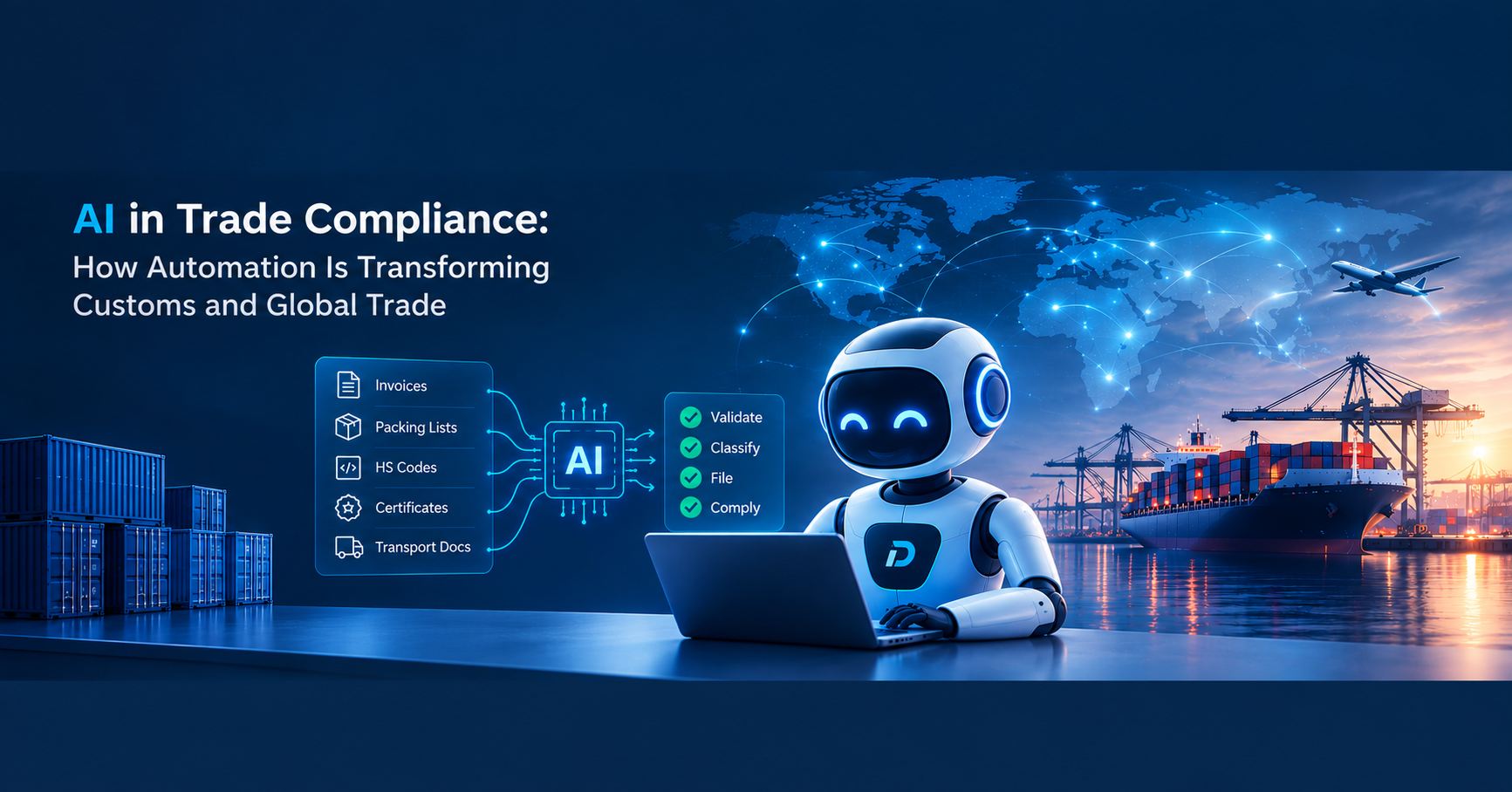
AI in Trade Compliance: How Automation Is Transforming Customs and Global Trade
• Understanding AI in Trade Compliance • How AI Is Transforming Customs Compliance • AI-Powered Automation Across the Customs Workflow • Key Benefits of AI for Trade Compliance Teams • AI and Risk Management in Global Trade • AI in Trade Compliance for Different Industry Stakeholders • Challenges of Implementing AI in Trade Compliance • What the Future of AI-Powered Trade Compliance Looks Like • Conclusion • FAQ
Doing global business is never easy. When you send something internationally, you deal with invoices, packing lists, HS codes, customs declarations, certificates, transport documents, duties, and regulations in several places. Now, add to this the constantly changing legislation, increasing volume of shipments, greater difficulty of customs checks, and pressure to swiftly deliver goods. It becomes increasingly complicated for importers/exporters/customs brokers/logistics providers to do everything manually.
This is how AI in customs compliance is reshaping the way companies process customs and international shipments.
There is no need to rely solely on people who read documents, enter information, check requirements, find mistakes, and compile declarations; AI makes it possible to switch to automatic processing of routine processes while still involving compliance specialists in making crucial decisions.
But what is it actually meant by AI?
Is it just a more rapid data entry tool, or may it be a new game changer for customs compliance?
The answer lies somewhere in the last statements – AI allows tying documents together, tracking shipment information, checking regulations and risks, and automating customs processes.
Understanding AI in Trade Compliance
What Trade Compliance Involves Across Global Supply Chains
Trade compliance refers to the measure which makes sure that the international shipments comply with the respective legislations, documentation practices, regulations, and customs procedures of the countries involved. For an exporter or importer, this may entail:
- Correct classification of the products
- Value of customs
- Requirements in terms of origin
- Documents and papers for imports and exports
- Calculating taxes and duties
- Requirements concerning identification of traders
- Making customs declarations
- Restrictions imposed by regulations
- Keeping records and reporting
The problem is that compliance does not mean carrying out one activity related to only one document or department.
For instance, a commercial invoice can have the necessary information regarding the products as it contains the data on their classification and the values. The packing list contains the quantities and packing, while transport documents can comprise shipment data. Thus, customs require the information in special data fields created for these documents. Owing to these factors, the data should be accurate when it comes to compliance.
Why Traditional Customs Processes Create Delays and Errors
Various organizations continue to rely heavily on manual processes. In manual processing, a worker receives an invoice, opens it, checks for information, transfers the information to another system, revises it, and prepares the declaration. This process seems easy and manageable when only a few shipments are involved.
However, the situation changes radically with larger volumes of shipments. More shipments imply more papers, more data fields, more chances for incorrect development of data, and more burden on compliance. Manual operations also cause performing repetitive actions which could be done by computers without requiring human mind.
This is one of the reasons for trade automation becoming more and more important. Automation will not replace professionals but rather help them with relieving them of routine job.
The Growing Role of AI in Customs and Trade Operations
Artificial Intelligence brings automation to the next level. Conventional automation typically operates according to established protocols: for example, if a certain field is available, it needs to be transferred elsewhere.
AI can handle more complex types of data. It is capable of analyzing texts, identifying regularities, retrieving information, making comparisons, spotting discrepancies, and presenting data for further use. According to the WCO, AI and machine learning are now impactful in customs functions via automation, risk evaluation, fraud prevention, forecasting, and making the processes of clearance more efficient. As a result, we can migrate from classic automation to AI-enhanced compliance practices.
How AI Is Transforming Customs Compliance
Automating Customs Data Entry and Document Processing
One of the most straightforward uses of artificial intelligence is document processing. People who work in trading work with such documents as PDF files, invoices, packing lists, spreadsheets, XML files, and others. Important information needed for customs purposes can be presented in many different ways depending on different suppliers or trading partners. Technology based on AI can recognize the necessary fields and convert the unstructured information into useful data.
For instance, an AI system can be able to recognize:
- The names of the shipper and the consignee
- Descriptions of the goods
- Quantities
- Currency
- Commercial value
- HS codes
- EORI number
- Transport information
Instead of typing everything again manually into a customs system, the information can be extracted properly and used appropriately. This is especially necessary for companies that work with big volumes of shipments.
Extracting and Validating Data from Trade Documents
The extraction alone will not suffice. There might be a discrepancy between the invoice and the packing list by the quantity stated on each one. Or the product description might not be precise enough for the needed customs procedure. Merely extracting the information faster does not mean solving the original problem.
Using AI can assist in comparing the data in the documents and spotting potential inconsistencies prior to submission. This makes the workflow really efficient:
Document – AI extraction – Verification – Exception detection – Manual checking – Declaration
This method combines the machine speed and human monitoring.
Identifying Missing or Incorrect Customs Information
Absence of information may be a huge source of delays. The declaration should contain information, which may not be present in the trade documents. AI verification can help detect the missing fields and inconsistencies before the declaration has been submitted to customs authorities.
This is particularly useful, given that customs authorities tend to increasingly utilize the preliminary information and analysis of risks.
Automating Classification, Valuation, and Compliance Checks
Another key opportunity is enhancing classification and compliance assessments. HS classification, valuation, source, and compliance requirements may encompass extensive quantities of information and specialized expertise. AI can support teams in systematizing relevant information, recognizing possible classification problems, verifying information against existing norms, and recognizing items needing more examination.
At the same time, organizations shouldn't consider AI results automatically accurate because it is generated through an advanced model. Effective trade compliance technology strategy includes validation, confidence score, human verification, auditing trails and clear responsibility.
AI-Powered Automation Across the Customs Workflow
From Commercial Invoice to Customs Declaration
Take the example of a standard shipment. The compliance team gets the invoice and the required papers. Traditionally, the process requires a person to read those documents, find useful information, enter it into the customs system, perform a check, and prepare the customs declaration. With the help of AI, these processes can be linked together.
For example, at Droblet, the platform is built to read trade documents, find the necessary information regarding the shipment, verify this information, follow compliance procedures and perform customs declaration submission. As a result, in this case, we obtain a process at which information flows through the steps of the workflow.
Automating ENS, ICS2, and Advance Cargo Information
For another crucial area of automation process, we can look at advance cargo information. According to the Commission of Europe, ICS2 is a system for advance cargo information designed to collect information regarding safety and security via the ENS stage filing.
In the case of businesses dealing with a large number of shipments, the process of collecting the data can be tiresome. AI technologies can help collect the data needed for submitting it to customs.
As an example, Droblet uses ICS2 to show how the e-filing of customs documents works. This is just another example of how automation can ensure efficient customs compliance.
Connecting Customs Systems Through APIs and Integrations
Artificial intelligence becomes more effective when connected to an existing system of the enterprise. Traditional processes of international trade utilize the following systems:
- ERP systems
- Transportation management systems
- WMS
- Customs management systems
- CRM systems
- e-Commerce systems
With the help of APIs and integrations, trade companies do not have to make their employees take data from one system and enter it into another system manually. This results in more integrated intelligent trade processes, as the data passes through the whole chain of trade, from the original transaction through logistics and customs processes.
Creating Faster and More Consistent Compliance Workflows
While speed can be important, consistency has equal significance as well. A manual procedure relies on the person carrying out the task, while an automated operation employs similar validation steps every time. It does not mean that human input is completely removed from the process. Instead, it helps compliance officers to work in the organized way as they are able to automate most of the routine tasks and focus on the rare exceptions.
Key Benefits of AI for Trade Compliance Teams
Reducing Manual Work and Processing Time
The primary advantage of AI use is productivity improvement, as AI effectively processes all documents, including reading, extracting, validating, and preparing data repeatedly, allowing workers to reduce the time spent on administration.
As shipment volumes rise, this becomes highly important. Rather than constantly adding people as transaction volumes increase, increasing the level of automation will let companies deal more with the repetitive workload.
Minimizing Customs Errors and Compliance Risks
Mistakes in trade documents can cause delays, extra costs, adjustments, and issues with authorities. AI-enabled validation checks for problems before documents are submitted. The key difference is that AI should assist compliance teams instead of inducing false confidence.
Human examination is key in difficult situations, such as ambiguous goods descriptions, rare shipments, complicated rules, and results that might be uncertain.
AI and Risk Management in Global Trade
Detecting Compliance Anomalies and Data Inconsistencies
Artificial Intelligence systems are capable of assessing extensive data in a much shorter time frame than a human doing the work manually. They can find uncommon trends, invalid data, missing descriptions, and discrepancies between similar documents. However, this does not necessarily mean that every anomaly indicates a violation. AI can rather assist in identifying what is worth focusing on.
Identifying Potential Customs and Documentation Risks
Risk management is an increasingly important component in contemporary customs work. According to the research conducted by the WCO, the areas which might benefit from the implementation of AI/ML technologies include risk management, intelligence, predictive analytics, and real-time processing.
In the view of companies, this opens up new opportunities of progressing from merely checking if the documents are correct after their completion to foreseeing potential threats at earlier stages of the process.
AI in Trade Compliance for Different Industry Stakeholders
How Importers and Exporters Can Simplify Compliance
Importing and exporting involves many operations with suppliers, products, countries, papers, and regulations. AI minimizes the labour of internal teams and provides better insight into compliance issues. Automation can be a good start for companies that are moving onto new markets.
How Customs Brokers Can Process More Declarations
Customs brokers have a lot of pressure. They need to work with a correct data flow under stressful conditions, dealing with various customers or kinds of shipments. Thus, the benefit of AI is that it allows automating the time-consuming tasks with papers and documents.
Challenges of Implementing AI in Trade Compliance
Data Quality and Standardization Challenges
In regard to AI, it holds no value unless fed information of good quality. Data quality is thus necessary to be addressed by enterprises simultaneously with adopting AI. The WCO underlines the significance of the data involved in the use of AI/ML solutions in customs.
Integrating AI With Existing Customs Systems
Many organizations have their customs, ERP, TMS and logistics systems already in place. Replacing all the systems usually is impractical. Integrating AI into the existing processes via the use of structured information exchange and APIs is a much better option.
What the Future of AI-Powered Trade Compliance Looks Like
Moving From Reactive Compliance to Predictive Risk Management
Trade compliance is expected to include predictive features in the future. Rather than finding out about issues only after a declaration has been filed or shipment has been held back, companies would be more advanced at finding problems. Artificial intelligence would be able to provide answers to questions like:
- What shipments need additional checks?
- What documents may contain mistakes?
- What goods bring the same classification problems?
- Where bottlenecks in compliance process appear?
- What changes in regulations influence some particular shipments?
Compliance would shift from being reactive to actively predictable.
Increasing Use of Intelligent Customs Automation
The next phase of automation will involve connecting numerous stages of operation rather than administration of one task. A robotized system built in the future will begin with commercial documents, take the necessary data from it, check it for compliance, issue a declaration, report it, handle replies, and create an audit trail.
Conclusion
Artificial intelligence is transforming what technology means for compliance in trade. The goal is not simply to speed up customs data input, but instead to take compliance to another level, with the opportunity to build a more interconnected, precise, and proactive process.
Artificial intelligence solves the problem of repetitive operations in different areas, from document extraction and validation to customs declarations, risk identification, integration, and audits, allowing compliance specialists to put their experience in critical decisions.
Companies do not have to ask if trade will become digital; instead, they have to focus on the speed of adaptation of compliance processes. Companies using AI-based compliance in conjunction with automation, good utilization of data, and human supervision will be more capable of managing a complicated situation. And as customs authorities will implement technological solutions, intelligent automation will consequently grow in importance.
If you want to explore how AI can be applied to customs workflows, explore Droblet's AI-powered trade and customs compliance platform to see how document extraction, ENS, ICS2, ELO, CDS, and customs workflows can be brought together in one platform.
Frequently Asked Questions
What is AI in trade compliance?
AI uses artificial intelligence to automate document processing, data extraction, validation, risk checks, and customs workflows.
How does AI improve customs compliance?
AI helps identify missing information, data inconsistencies, and potential errors before customs declarations are submitted.
Can AI replace trade compliance teams?
No. AI supports compliance professionals by automating repetitive tasks while humans handle complex decisions and exceptions.
What are the benefits of trade compliance automation?
It can reduce manual work, improve data accuracy, speed up processing, and help businesses manage higher shipment volumes.
How can businesses start using AI for trade compliance?
Businesses can begin by automating document extraction, data validation, customs workflows, and integrations with existing trade systems.
Rudratej Patil
Co-founder
Droblet Technologies